

Round Rock, Texas · Raised floors and crawl spaces
Pier and Beam Foundation Repair in Round Rock, TX
Raised floors, older houses, and the shims and supports that hold them up.
A soft spot in the hallway, a floor that rolls toward one wall, or a gap opening under the baseboards can all point to the supports under a raised house. Pier and beam foundation repair in Round Rock, TX and the towns around it means working from the crawl space: resetting supports, replacing tired shims and fixing framing that has sagged. The first step is finding out which supports have moved, and by how much.
- Free inspection
- No obligation
- Town-by-town soil data
- Referral service, disclosed
- Call (737) 259-7007
What have you noticed?
A free inspection gets someone under the house with a light and a level.
What Pier and Beam Foundation Repair Fixes
In a pier and beam house, the floor sits on wood joists. The joists rest on beams, and the beams rest on short piers standing on the ground, with a crawl space underneath. When one pier sinks, a shim crushes or a beam sags, the floor above it drops. The repair deals with:
- Floors that slope, bounce or feel soft in one area
- Gaps under baseboards or between the floor and the wall
- Interior doors that drag or won't latch
- Cracks in drywall above doors and windows
- Supports that have sunk or cracked apart
The Texas engineering guidelines give a useful sense of scale. They say a floor tilt of more than 1% is usually noticeable, which is about 1.2 inches over 10 feet. A slope you can feel underfoot is worth measuring.
West of I-35 or East: What Changes
Raised houses tend to be older houses, and the oldest homes we serve are on the clay side of our area. The Census counts build years, not foundation types, so read this as a likelihood rather than a fact about your house.
Taylor and Elgin hold the older homes. In Taylor, 17.2% of homes were built before 1940 and 28.6% before 1960, and the median home dates from 1978. Elgin's median is 1979, with 23.5% of homes built before 1960. Round Rock's figure for before 1960 is just 1.6%. A source on Austin-area pier and beam work says 1940s and 1950s homes often sit on their original cedar posts or concrete blocks.
The soil under those older houses moves. Branyon clay, the top soil in Taylor, reads 9.9 on the USDA's shrink-swell scale in its first foot and 13.0 below that. One company describes block-and-base construction as concrete blocks stacked on small concrete pads right at the surface. In Taylor, pads like that rest in Branyon's top foot, which already falls in the USDA's very high band (anything over 9). Elgin is different. Its top soil, Crockett, has about 8 inches of sandy loam reading 1.2 over a clay layer reading 9.0, so the surface can look harmless while the clay below still moves.
In the limestone towns, most homes are young: 92.1% of Leander's were built in 1990 or later, and 86.5% of Cedar Park's. If a pier does sink where the rock sits close, it's worth checking for water collecting under the house as well as for a support that has simply worn out.
What the Work Involves
- A crawl space inspection. The professional checks each pier, shim and beam, and measures the floor to map the low areas.
- A plan. Taylor's city checklist, as we could read it, asks for a layout of each pier and its spacing, and marks which piers need shimming. It also asks for an engineer-sealed section showing the clearance between the pad and the beam. Round Rock and Georgetown want an engineer's stamped plan for any foundation repair permit. Confirm the current rules with your city.
- Supports reset or added. Sunken or cracked piers are rebuilt, and new supports go under spans that sag.
- Shims replaced. One repair company says that wooden shims and blocks can compress over time, and uses steel shims for lasting support.
- Framing repaired. Decayed or cracked beams and joists are reinforced or replaced, then the floor is brought back toward level.
The same honest limit applies as on a slab. The Texas guidelines say lifting is unlikely to leave a floor perfectly level. A good result is a floor that's near level, feels solid and stops getting worse.
How a raised floor is held up
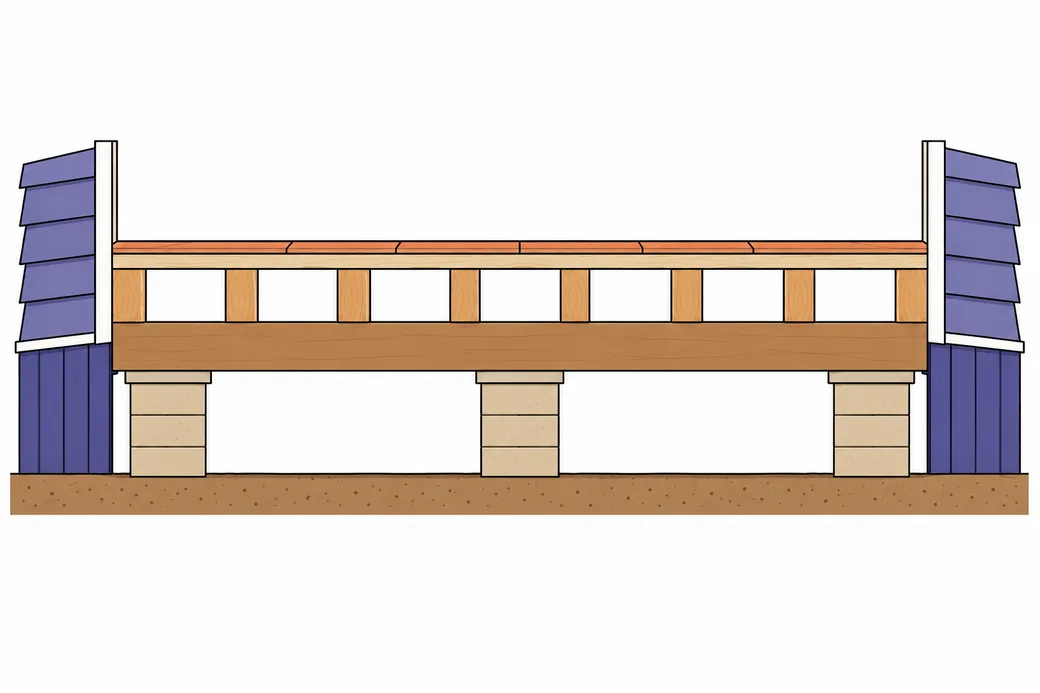
- Short masonry piers stand on the ground
- A timber beam rests on the piers
- Floor joists and the floor sit on the beam
- Open crawl space under the floor
What It Costs
We haven't found a published pier and beam price list from a company working around Round Rock. The lists we did find price slab piers, not shims or beams, so we won't borrow those numbers for this page. What moves the price is how many supports need work, whether any framing has decayed, and how easy the crawl space is to get into.
Two costs are worth planning for either way. One Austin cost guide puts an engineering report at $500 to $1,500, and the permit fee is $125 in Round Rock and $50 plus a $10 technology fee in Georgetown. Taylor sets its fee once the application is accepted. Our cost guide has the full price picture.
Questions About Pier and Beam Foundation Repair
Is my house raised, or on a slab?
Look for a crawl space: vents or a small access door along the base of the outside walls, and a floor that sits a step or more above the ground. A slab house sits right on the ground with no space underneath.
What does Taylor ask for before the work?
Taylor's foundation repair checklist, as indexed online, asks for an engineer's stamped plan of the whole foundation, with separate drawings for pier and beam houses, and staff approval of the application. We couldn't open the city's own page, so check with Taylor before work starts.
Can I just add shims myself?
Check with your city first. Taylor's checklist, as we read it, makes shimming part of an engineer-sealed plan, and Round Rock and Georgetown ask for an engineer's plan for any foundation repair permit. A free inspection will show what's actually going on under the floor.
Related Services
- House leveling: when the whole floor has drifted, not just one span
- Foundation inspection: a measured look before any work is planned
- Slab foundation repair: the different job of piering a concrete slab
Towns We Serve
Older raised homes are likeliest in Taylor and Elgin, but we cover every town on our list, including Georgetown, Hutto, Manor, Pflugerville, Wells Branch, Brushy Creek, Cedar Park, Leander and Liberty Hill. See all service areas.
Get a Free Pier and Beam Inspection
Tell us what you've noticed underfoot and the town or ZIP code of the house. We'll pass it to a local foundation repair professional, who'll look under the floor and explain what they find. The visit is free.
What have you noticed?