
Short answer: the Edwards Aquifer recharge zone is where the aquifer's limestone reaches the surface, so rain can soak straight down into it. Texas rules cover building and digging there, and they leave out routine upkeep of an existing building. No source we've read says which side of that line a foundation repair falls on. If your house is over the zone, ask before any digging starts. It takes one phone call.
Key facts
- On TCEQ's Edwards Aquifer map, the recharge zone covered 92% of our Georgetown sample points, 84% of Brushy Creek's and 40% of Round Rock's.
- None of our points in Hutto, Manor, Taylor or Elgin fell in any of the aquifer's zones.
- The state rule covers "construction of buildings" and excavation on the recharge zone, and excludes "routine maintenance of existing structures that does not involve additional site disturbance."
- TCEQ's Austin office covers Williamson, Travis and Hays counties: 512-339-2929.
What the Recharge Zone Is
The Edwards Aquifer is a set of limestone layers that holds water underground. The recharge zone is where that limestone comes to the surface. Texas rules describe it as the area where the aquifer's rock layers crop out. There, openings in the rock let surface water get in. The rule names caves, sinkholes, faults and fractures among them.
That's the point of the zone. Rain that falls there doesn't just run off. Some of it soaks down through cracks in the rock and ends up in the aquifer, so what happens on the ground can reach the water below. The rules exist to keep pollution out of it.
Two other zones sit beside it. The transition zone lies just south and southeast of the recharge zone, where some of the same kinds of features may let water in. Its rock layers include the Austin Chalk, which is under much of Round Rock. The contributing zone is drawn by county in the rules. In Williamson County, it takes in the whole county except the land draining to the Lampasas River above the dam at Stillhouse Hollow.
How rain reaches the aquifer
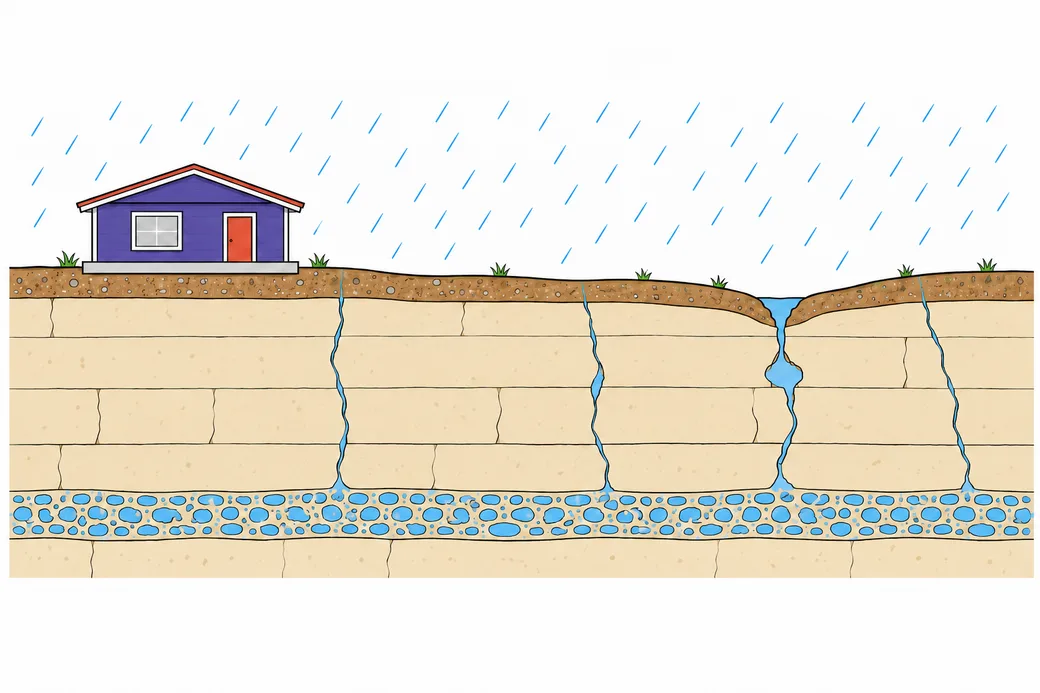
- Rain soaking into the ground
- Cracks in the limestone carry water down
- A small sinkhole opens at the surface
- Water held in the rock below
Which Towns Sit Over It
We checked TCEQ's online Edwards Aquifer map at the same 25 points we used for each town's soil. Here's how the towns we serve came out:
- Georgetown: 92% recharge zone, 8% contributing zone
- Brushy Creek: 84% recharge zone, 16% contributing zone
- Round Rock: 40% recharge zone, 24% transition zone, 36% outside every zone
- Wells Branch: 28% recharge zone, 44% transition zone, 28% outside
- Cedar Park: 24% recharge zone, 64% contributing zone, 12% outside
- Leander: 88% contributing zone, 12% outside
- Liberty Hill: 100% contributing zone
- Pflugerville: 4% transition zone, 96% outside
- Hutto, Manor, Taylor and Elgin: 100% outside every zone
The aquifer line and the soil line run together. Georgetown and Brushy Creek, the towns with the most recharge zone, sit on the limestone side, where the rock lies close to the surface. Hutto, Manor, Taylor and Elgin, the deep clay towns to the east, sit outside every zone, and Pflugerville almost entirely.
A 25-point sample tells you about a town, not a street. Round Rock is split three ways, so two houses in the same town can sit in different zones. TCEQ says its official maps are the ones kept at its offices. To check one property, look it up on TCEQ's map viewer and confirm with the agency.
What the State's Rules Cover
The rules are in the Texas Administrative Code, Title 30, Chapter 213. Three parts of them matter for a house.
On the recharge zone, the rule covers "regulated activities." That means construction-related work that could pollute the aquifer. It names "construction of buildings." It also names "excavation" and other work that disturbs the ground or how water soaks into it.
The same rule leaves out routine upkeep. It excludes "routine maintenance of existing structures that does not involve additional site disturbance." Its examples are resurfacing paved roads, parking lots and sidewalks, and building fences.
On the contributing zone, the bar is much higher. That part of the rules applies only to work that disturbs at least five acres, or that is part of a larger plan that will. A repair on one house is far below that.
TCEQ also has a page for private homes. It says building at a home on the recharge or contributing zone falls under these rules.
A plan may not be needed if the home is part of a larger development that already has an approved plan, or on a lot over five acres with one house. It also may not be needed if the work keeps impervious cover at or below 20% of the lot. Impervious cover means surfaces that water can't soak through. TCEQ's list includes rooftops and driveways, plus concrete pads, sheds and sidewalks.
That page talks about new building and rebuilding. It doesn't mention repairs to a house that's already there.
Where Foundation Repair Falls
Here's the honest gap. A foundation repair on a slab usually means digging holes beside the house, and sometimes through the floor, to put piers in. That is digging. It's also work on an existing building that may add nothing new to the site. The rule covers the first and excludes the second, and we haven't found anything from TCEQ that says where repair piers land.
So we won't tell you a repair over the recharge zone is exempt, and we won't tell you it needs a plan. The safe step is to ask before any digging starts.
- TCEQ Austin Region, Edwards Aquifer program: 512-339-2929, or [email protected]. The Austin office covers Williamson, Travis and Hays counties.
- The repair company: ask whether it has done piers over the recharge zone before, and what, if anything, it filed.
- What to ask TCEQ: whether installing repair piers under an existing house on the recharge zone is a regulated activity, and whether anything needs to be filed first.
This is a separate question from your city permit. Round Rock and Georgetown both issue foundation repair permits with an engineer's stamped plan. Brushy Creek has no city at all, and Williamson County has no residential building permit, but the state rule covers the recharge zone whether or not a city does.
New Concrete Is Easier to Answer
Some repairs come with extra work around the house: a wider patio, a concrete pad for drainage, a new walkway. Those add impervious cover, and TCEQ's page for homes treats new concrete pads and sidewalks as part of a home's impervious cover. If your lot is on the recharge or contributing zone and close to 20% already, ask about that part of the job too.
Draining water away from the house is still good practice. The Texas engineering guidelines recommend a 5% fall away from a foundation for the first 10 feet. How you get there, with soil or with concrete, is where the 20% rule can come in.
Does the Aquifer Make a House Move?
No source we've found ties the aquifer itself to foundation movement. The zone is about water quality. What moves a foundation is the ground right under it. In Georgetown and Brushy Creek, most of that ground is Eckrant or Georgetown soil, with rock within about 3 feet of the surface.
That doesn't mean nothing moves. Georgetown soil, nearly half of Brushy Creek's sample and 20% of Georgetown's, has a top layer reading 2.5 on the USDA's shrink-swell scale over a 70% clay layer reading 8.5. Our Round Rock soil guide covers what's under each town, and why rock close to the surface still leaves some soils that swell.
Questions About the Recharge Zone
Is all of Round Rock over the recharge zone?
No. In our sample, 40% of Round Rock's points were on the recharge zone, 24% on the transition zone and 36% outside every zone. Check your own address on TCEQ's map.
Does the contributing zone affect my repair?
Very unlikely on its own. That part of the rules applies to work disturbing five acres or more, or part of a larger plan that will.
Will a repair company know the rules?
Ask. A company that works in Georgetown and Brushy Creek may well have dealt with the question, and its answer is worth comparing with TCEQ's.
Get a Free Foundation Inspection
If your house is over the recharge zone and something has started to move, a free inspection is a good first step. Tell us what you've noticed and the town or ZIP code of the house, and a local foundation repair professional can come out to measure. Any digging can wait until you've had your answer from TCEQ.